





Ofsted inspections explained
With the introduction of the new report card inspection system by Ofsted, there are now three different types of inspection that a school can currently have as its most recent inspection. This makes comparing schools using Ofsted ratings increasingly difficult; as you are comparing inspections carried out under different regimes with each other. This article explains the various changes to the Ofsted inspection system and how each type of report is shown in Locrating and how you might compare them, including with the Locrating Inspection Rating.
The easiest way to follow these changes is to read the following timeline:
The traditional inspection framework
When Locrating first started, in 2010, Ofsted was using a framework where schools received an overall effectiveness grade, which was either outstanding, good, requires improvement or inadequate.
Schools also received grades based on how they were rated in particular areas such as the quality of education, leadership and management, behaviour and attitudes etc.
The single word headline grade was actually determined by the rating given to each category, e.g. a school that scored good in each category was given a headline rating of good.
Ignoring some edge cases, essentially the school was rated overall the lower of its category scores, e.g. if rated outstanding in all categories but one, which was good, the school would be rated "good" overall, despite having more "outstanding" ratings in the categories. Early years provision was the one category that had less impact on the overall score.
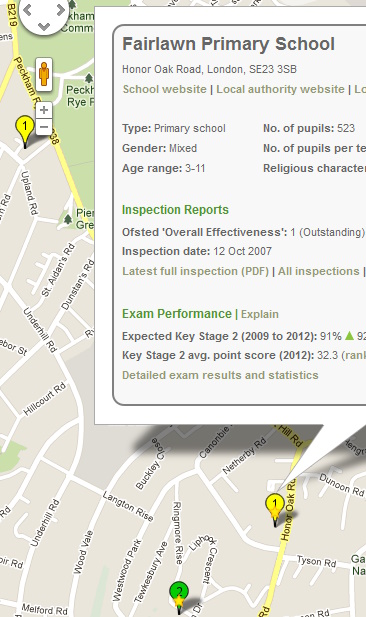
2010: Locrating is born
Locrating started in 2010. The name locrating is a play on words; "Locrating" meaning to locate by [Ofsted] rating. The fundamental feature of the site was showing schools on a map coloured by their Ofsted rating, so parents could see at a glance the rating of every school. This was something that, at the time, existed nowhere else.
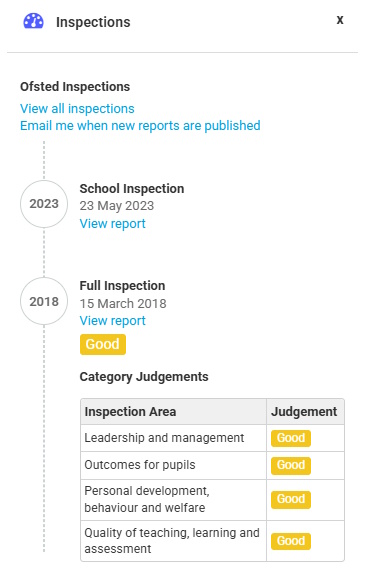
How these inspections appear on Locrating
When clicking on a school, that has one of these traditional full inspections users see the category grades and also the overall rating, as shown above for the inspection on 15 March 2018.
Schools could also receive other types of (non-full) inspection and in these inspections, there are no categories or overall grade. There might be wording to indicate if the school remained at the same level or not, e.g. "The school continues to be a good school". These are shown on Locrating with no grade or categories (as above for 23 May 2023). These reports don't change the official rating of the school and so the school's overall rating on Locrating remains the one from the last full inspection.
These inspections continued until September 2024 and so the vast majority of schools currently have these inspections as their most recent.

Locrating headline rating
The headline for the school in the popup, is the most recent grade and that is how the school is coloured on the map.
2023: The death of Ruth Perry
Ruth Perry was a headteacher at Caversham Primary School, who sadly took her own life in January 2023 after an Ofsted inspection downgraded her school from "outstanding" to "inadequate".
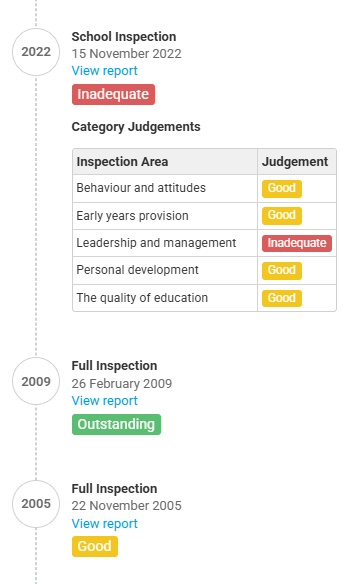
As shown above, the school was rated good in all areas, except leadership and management which is what prompted the school to be downgraded to inadequate overall, despite being good in most areas.
The coroner ruled the inspection "contributed" to her death prompting a national debate over inspection practices and sparking widespread calls for reform, including the abolition of single word judgements.
2024: Immediate policy and reform responses
Following public pressure, the government announced that single word inspection grades would be scrapped from September 2024, but that schools would still receive category grades for the current academic year, whilst they planned for a different system.
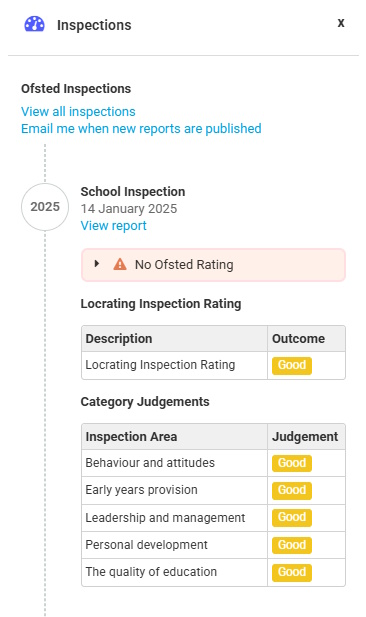
How these inspections appear on Locrating
At the time of writing, roughly 10% of schools have these inspections, where there is no overall grade, as their most recent inspection.
As shown above, we continue to show the category scores as before, but this change introduced an issue. How do parents compare schools, some of which have overall scores and others which don't?
As we knew the overall score was primarily calculated from the category scores we decided, at least as a temporary measure until the new regime became clear, to create a "Locrating overall rating" using an almost exact approach taken by Ofsted previously, so parents could still meaningfully compare schools and see at a glance on the map which schools have which ratings.
We obviously realised that this was essentially continuing single word judgements on Locrating, but it was clear to us from conversations with parents that many still wanted a mechanism to compare schools at a glance and this seemed the most reasonable solution to choose, whilst also contemplating alternative solutions; which we have now implemented and which will be discussed below.

Locrating headline rating
We removed the headline rating from the school popup and replaced it with the category scores, with acronyms for each, e.g. EYP = Early Years Provision.
On the map the school is coloured with the Locrating rating, otherwise on the map these schools would be grey, which we felt was not helpful to users.
As context over 80% of these Locrating ratings are outstanding or good, with only 2% being inadequate.
2024: Plans for "Report Cards" announced
The Department for Education and Ofsted revealed intentions to replace the old grading system with a more detailed “report card” that would assess multiple areas and provide richer commentary for parents.
These would start in September 2025 with the inspections being published starting around January 2026.
2026 Report card inspections published
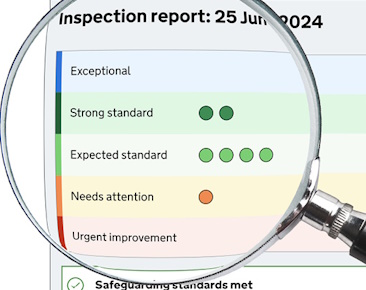
The new report card system appears to be little more than the same category system as previously; albeit rebranded, with new categories, new grades and a new "report card" info-graphic to show these grades.
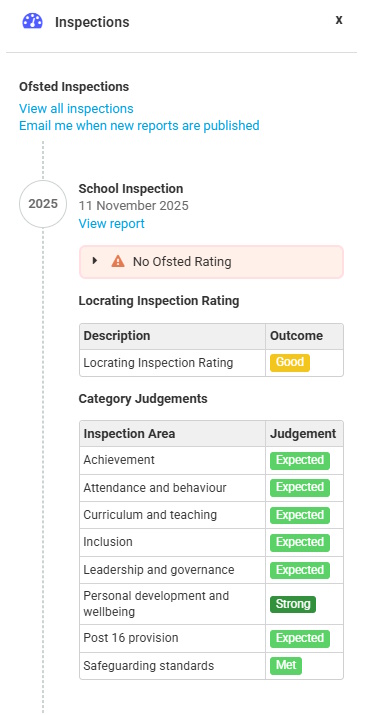
As such, the Locrating interface has remained the same and we show the categories and grades next to them exactly as before, except we are now using the new grade names and colours as used by Ofsted (e.g. Exceptional is blue, Strong Standard is dark green etc.)
Once again there is the issue of not being able to directly compare schools, compounded by now three different possible report types.
We are continuing with the Locrating rating, using the same algorithm applied to the new report card categories as was applied to the previous categories.
However, as will be described below, this is now just one of the options that can be used to colour schools on the map, with other options also available, that are more in keeping with the removal of single word judgements.
Over time, as more schools get report cards, these alternative options will become more significant and the Locrating rating may be removed.

Locrating headline rating
The headline rating has also remained the same, except there is not enough space for the category acronyms and so we display coloured dots, again using the same colours as Ofsted. Hovering over the dots shows the category names as a tooltip.
Configurable school colours
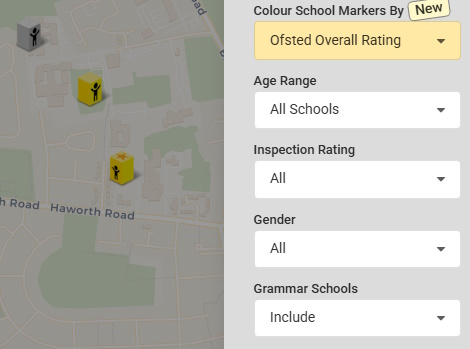
Our final part to the solution is to allow users to configure how they want the schools to be coloured on the map.
For those that wish to have them all coloured, in a summary score fashion, they can choose to colour them by Locrating rating. This will show the overall rating given by Ofsted where available and otherwise an overall score generated from the report categories. There is one caveat to note, to retain the same four colour grading scheme, the report card scores "strong standard" and "expected standard" are both treated as being "good" (for the other report card scores, "exceptional" is treated as "outstanding", "needs attention" as "requires improvement" and "urgent improvement" as "inadequate").
Or users can view just the official overall Ofsted ratings, and schools will be grey if inspected after September 2024.
For those that wish to follow the governments approach of no headline ratings at all, they can colour schools instead by the different categories to compare schools, e.g. leadership and management. This means you can't compare schools' overall ratings, but you can compare them based on their scores in each category. Although as the categories changed in report cards, you can't directly compare schools inspected last before September 2025, with those last inspected after.
We believe this offers maximum flexibility, retaining the ability to compare schools at an overall level, but further allowing the comparison of schools by more low-level categories.
Users can of course mix and match using a combination of the above, in different searches, to ultimately select schools.